
An ETP plant, short for effluent treatment plant, is a facility that cleans industrial wastewater before it is discharged or reused. It removes solids, oil, chemicals and dissolved organic waste in sequential physical, chemical and biological stages. In Bangladesh, many industries, especially textile dyeing units, must treat their wastewater to legal limits.
This guide explains the meaning of an ETP plant, how it works, its five treatment stages, its equipment and the numbers that decide compliance. Readers who already have their answer and are planning a project can review the scope of ETP plant design and installation in Bangladesh.
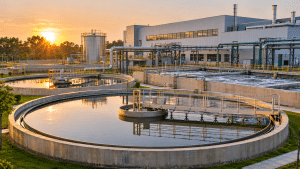
What Is an ETP Plant at a Glance?
An ETP plant is a multi-stage system that treats a factory’s process wastewater so the water can be discharged safely or reused. The essentials fit into six points.
- Full form: Effluent Treatment Plant.
- What it treats: Production wastewater that carries dyes, oils, chemicals, metals and organic waste.
- How it works: Physical, chemical and biological treatment run one after another.
- The 5 stages: Preliminary, primary, secondary, tertiary and sludge management.
- Who needs one in Bangladesh: Industries that discharge liquid waste, with textile dyeing and chemical units in the strictest “red” category.
- Main legal reference: The Environment Conservation Rules, 2023.
The Built, Running, Within-Limits Test for an ETP Plant
The built, running, within-limits test is a three-part check that shows whether an ETP plant in Bangladesh really protects the environment. Many guides stop at “install an ETP”. In practice a plant must pass three separate tests, and many pass only one or two.
- Built: The plant exists, and its design received approval.
- Running: The plant operates every day, not only before an inspection.
- Within limits: The treated water meets the legal numbers for pH, BOD, COD, colour and other parameters.
Recent reporting shows how often the first test fails. A BIWTA action plan, reported by Dhaka Tribune on 1 September 2026, says nearly 7,000 industrial establishments operate along the rivers around Dhaka. Around 99 per cent of them reportedly have no effluent treatment plant.
The other two tests fail more quietly. A plant can be built and then left idle, or it can run and still miss the limits. The sections below return to these three tests, so a reader can judge any plant, including their own.
What Is an ETP Plant? (Meaning and Key Terms)
An ETP plant is a treatment facility built to clean the wastewater that one factory produces. Think of it as a gatekeeper at the factory drain. Nothing leaves until it has been checked and cleaned.
Factory wastewater is a different problem from household sewage. Dye houses, laundries and chemical units add colour, heavy metals, oil and a heavy organic load. Ordinary drains and municipal sewage plants are not designed for that mix.
Key terms you will meet in every ETP report
These nine terms appear in almost every design drawing and test report.
| Term | Meaning |
| Influent | Raw wastewater entering the plant. |
| Effluent | Treated water leaving the plant. |
| Sludge | Solid waste that settles out during treatment. |
| BOD (Biochemical Oxygen Demand) | Oxygen that bacteria use to break down organic matter. A higher value means dirtier water. |
| COD (Chemical Oxygen Demand) | Oxygen needed to chemically oxidise all pollutants. It is usually higher than BOD and faster to test. |
| TSS (Total Suspended Solids) | Fine solid particles floating in the water. |
| TDS (Total Dissolved Solids) | Salts and other substances dissolved in the water. |
| pH | A scale showing how acidic or alkaline the water is. |
| DO (Dissolved Oxygen) | Oxygen present in the water, which both bacteria and fish depend on. |
ETP vs STP vs WTP vs CETP
ETP, STP, WTP and CETP are four different plants, and each one handles a different kind of water.
| Plant | Full form | Water it handles | Usual operator |
| ETP | Effluent Treatment Plant | Process wastewater from one factory | The factory |
| STP | Sewage Treatment Plant | Toilet, kitchen and washroom water | Building owner or local authority |
| WTP | Water Treatment Plant | Incoming raw water made fit for use | The factory or facility |
| CETP | Common Effluent Treatment Plant | Combined wastewater from a group of factories | The industrial zone or estate |
A factory with a large workforce often needs more than one of these. Process water goes to the ETP, and toilet and canteen water goes to an STP. Incoming raw water usually passes through a water treatment plant first.
Why Do Factories in Bangladesh Need an ETP Plant?
Factories in Bangladesh need an ETP plant to protect rivers, follow the law, save water and keep export orders. Each reason is covered below.
To protect rivers and fish
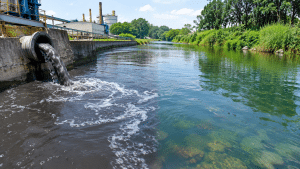
Untreated factory water changes the chemistry of a river. It lowers the oxygen level, kills fish and carries chemicals into soil and groundwater. A research booklet from the Stockholm Environment Institute notes that fish begin to suffer when dissolved oxygen falls below about 4 to 5 mg/L. A Prothom Alo report found that oxygen in parts of Dhaka’s rivers dropped to zero in dry seasons in recent years.
The scale of the problem is large. A BIWTA survey, reported by Dhaka Tribune in September 2026, counted 424 outlets sending about 330 tons of waste into the rivers around Dhaka every day. Industries accounted for nearly 60 per cent of that pollution. Globally, a 2015 UNEP report said that around 70 per cent of industrial discharge in developing countries goes untreated.
To follow the law
Textile dyeing and chemical processing units are classed as red category, the class that carries the greatest pollution risk. Under the earlier rules, these units had to submit an ETP plan to the Department of Environment (DoE) at the site clearance stage. They could apply for an Environmental Clearance Certificate (ECC) only after the approved ETP was built.
The Environment Conservation Rules, 2023 now apply. They took effect on 5 March 2023 and replaced the 1997 rules. An RMG Bangladesh summary of the 2023 rules says they added limits for colour, COD and temperature in textile wastewater. The same summary says they require discharge through specific, monitored points. Industry-specific duties differ, so confirm the schedule that applies to your category.
To reuse water and cut costs
Treated water can return to non-drinking uses such as washing, cooling and boiler feed. Reuse reduces groundwater pumping. It also lowers the water bill.
To meet buyer requirements
International brands look closely at how their textile partners handle wastewater. A booklet from the Stockholm Environment Institute and the Bangladesh Centre for Advanced Studies noted that buyers are paying closer attention to how textiles are made. It described an ETP as becoming a basic need for staying in the export market.
To protect workers and nearby communities
Chemical-heavy water that reaches ponds, canals and fields affects fishing, farming and drinking water sources. A working ETP keeps that exposure low.

How Does an ETP Plant Work? (Working Principle)
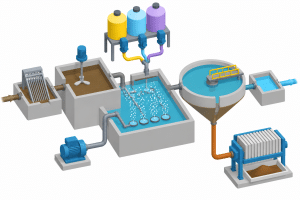
An ETP plant works by removing pollution in sequence, using three kinds of treatment. Each kind catches what the previous one missed.
- Physical treatment: Screens, settling tanks and filters pull out solids, oil and grease without adding chemicals.
- Chemical treatment: Chemicals correct the pH and make tiny particles clump together so they settle, and this also removes much of the colour.
- Biological treatment: Bacteria digest the dissolved organic waste and turn it into harmless by-products, which lowers BOD and COD.
Why the order matters
The order of treatment matters because each stage protects the one after it. The sequence is not arbitrary.
Treatment bacteria are sensitive. The Stockholm Environment Institute booklet explains that they work best at a pH of 6 to 8. Outside that range they slow down or die.
Some chemicals also poison bacteria. Physical and chemical steps therefore come first, so harsh or toxic material never reaches the living part of the plant. Rags and grit damage pumps, which is why screens come before everything else.
Operators take samples between stages. If a number is off, they adjust the chemical dose or the air supply.
What Is an ETP Plant Process? Follow the Water Through 5 Stages
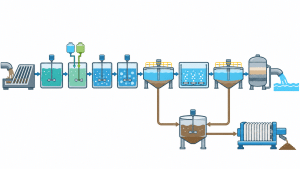
The ETP plant process has five stages, and dye-house wastewater passes through them in a fixed order. Each stage below explains what happens, what to check and the most common slip.
Stage 1: Preliminary Treatment
Preliminary treatment is the first stage of an ETP plant, where large and heavy material is screened out before it can damage equipment. Textile lint blocks screens quickly. The Stockholm Environment Institute booklet advises cleaning them every morning and evening.
- Equipment: Bar screens, fine screens, a grit chamber, and an oil and grease trap.
- Removes: Cloth scraps, lint, plastic, grit and floating oil.
- Common slip: Skipped screen cleaning, which blocks the flow and damages pumps.
Stage 2: Primary Treatment
Primary treatment evens out the flow, corrects the pH and settles suspended solids. A dye house may release a strong batch in one hour and almost nothing in the next, so the plant needs a buffer before the chemistry starts.
- Equalization tank: It collects and mixes all discharge so the plant receives a steady flow. The booklet suggests a volume of at least one third of the daily flow, about eight hours. A mixing agitator keeps solids from settling.
- pH correction: The water is brought to a pH of 6 to 8. Dyeing wastewater in Bangladesh is usually alkaline, so acid is needed more often than alkali.
- Coagulation: A coagulant such as alum makes fine particles lose their electric charge.
- Flocculation: A polymer joins those particles into larger clumps called flocs. The booklet recommends variable-speed metering pumps for this dosing, because manual valves are inaccurate.
- Clarification: The flocs sink as sludge and clearer water leaves from the top. Some plants add tube settler media so solids settle in less space.
This stage removes suspended solids, oil, part of the colour, and part of the BOD and COD. Operators run jar tests, which are small laboratory trials of different chemical doses. The common slip is dosing by colour alone. The same booklet found that light-coloured effluent sometimes had 1.5 to 2 times the oxygen demand of dark effluent. Dark water is not always dirtier water.
Stage 3: Secondary (Biological) Treatment
Secondary treatment uses living bacteria to digest the dissolved organic pollution that chemicals cannot remove. There are two main routes, and the choice depends on the strength of the waste.
| Aerobic | Anaerobic | |
| Air supply | Needed | Not needed |
| Power use | Higher | Lower |
| Best for | Medium organic load, such as textile effluent | Very high organic load, such as food and beverage effluent |
| Output quality | Higher | Usually needs a polishing step |
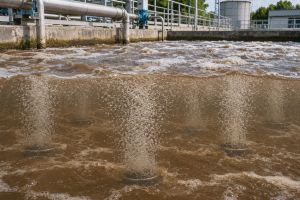
Aerobic systems include activated sludge, MBBR (moving bed biofilm reactor) and SBR (sequencing batch reactor). Anaerobic treatment happens in a sealed tank such as a UASB reactor. Aerobic plants depend on a steady air supply, which usually comes from a Roots or turbo air blower and an air diffuser that spreads the air through the tank.
Four checks keep the biological stage healthy.
- Keep dissolved oxygen at a healthy level, and inspect diffusers every three months for clogging.
- Run the unit around the clock. A short break of a few hours does little harm, but a long shutdown starves the bacteria.
- Add nutrients such as urea and ammonium phosphate when nitrogen and phosphorus are lacking, as they often are in textile wastewater.
- Test the Sludge Volume Index (SVI). A value of 100 ml/g or less means the sludge settles well, and a value above 150 usually points to bulking.
The common slip is letting the pH drift outside the 6 to 8 range, which weakens the bacteria.
Stage 4: Tertiary Treatment
Tertiary treatment polishes the water when earlier stages leave colour, fine particles or salts behind, for example before reuse. It is optional for some discharge routes and essential for others.
- Sand and carbon filters: They catch fine particles and some colour.
- Ultrafiltration and reverse osmosis: Membranes remove very fine particles and dissolved salts.
- Chemical oxidation or UV: Both break down stubborn colour and kill microbes.
The Stockholm Environment Institute booklet advises against chlorine for dye-house effluent. Chlorine can react with aromatic compounds in dye water and form harmful by-products known as AOX. Textile process water carries few disease-causing germs, so chlorination out of habit adds risk with little benefit.
Stage 5: Sludge Management
Sludge management is the final stage, where the solid waste left by every earlier stage is thickened, dried and disposed of. It follows four steps.
- Thickening: Excess water is removed so the volume shrinks.
- Dewatering: A filter press or screw press squeezes the sludge into a drier cake.
- Drying and storage: The cake is dried and kept safely until collection.
- Disposal: The sludge goes to an approved route under waste rules.
Plan the sludge route before the plant is built. Sludge holds the same pollutants that were taken out of the water, so it cannot be dumped on open land. Treating it as an afterthought is the most common slip at this stage.
What the water looks like along the way
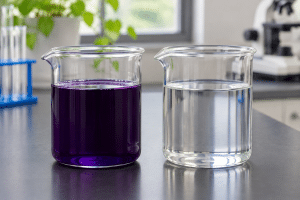
Water in a textile ETP changes visibly between the inlet and the outlet. Researchers who studied a textile ETP at Tongi, Bangladesh, reported dark blue inlet water. After several treatment units, the outlet water was a very light purple. A pale tint is encouraging, but only laboratory tests show whether the water passes.
What Is an ETP Plant Made Of? Main Parts and Equipment
An ETP plant is made of tanks, pumps, dosing units, blowers, filters and sensors that work together as one treatment line. Knowing the parts helps a reader check a design drawing or a quotation against the specification.
| Part | What it does | Stage |
| Bar screen | Catches rags, lint and large debris | Preliminary |
| Equalization tank and mixing agitator | Evens out flow and keeps the water mixed | Primary |
| pH and chemical dosing system | Adds acid, alkali, coagulant and flocculant in measured doses | Primary |
| Clarifier and tube settler media | Lets flocs settle out of the water | Primary and secondary |
| Aeration tank, blower and diffuser | Supplies the oxygen that bacteria need | Secondary |
| MBBR media | Gives bacteria a surface to grow on in compact tanks | Secondary |
| Pumps | Move water between tanks | All stages |
| Filters | Polish the water | Tertiary |
| Filter press or screw press | Dries the sludge | Sludge management |
| Flow meters and online analyser | Measure flow and water quality as they change | Monitoring |
Techno Bangla Creation Ltd., a Dhaka-based company that states 15+ years of industry experience, lists Roots and turbo blowers, air diffusers, EMEC and SEKO dosing pumps, flow meters, MBBR media, tube settler media and sludge presses among its equipment. The full range appears on the ETP, WTP and STP products page.
Types of ETP Plants Used in Bangladesh
The main types of ETP plants used in Bangladesh are physico-chemical, biological, combined, MBBR or MBR-based, zero liquid discharge and packaged units. The right type depends on what is in the water and how much of it there is.
| Type | Best suited for | Key point |
| Physico-chemical | Low organic load, color removal and metal removal | Uses chemicals and settling only |
| Biological | Food, beverage and dairy units with a high organic load | Relies on bacteria |
| Combined (physico-chemical plus biological) | Textile dyeing, printing and washing units | The most common setup for textile work |
| MBBR and MBR-based | Sites with limited space | Compact; an MBR plant adds a membrane filter to the biological tank |
| Zero Liquid Discharge (ZLD) | Facilities that aim to reuse all their water | No liquid leaves the factory |
| Packaged or mini ETP | Small factories | Delivered as pre-built units |
On ZLD, the environment minister said in August 2026 that a plan was under way at 46 industries along the Buriganga and Shitalakkhya rivers. Bio-chemical plants combine biological treatment with coagulation, flocculation and neutralization, and they suit effluent such as excess dye liquor from textile dyeing. The three main design routes are outlined under customized ETP plants for Bangladesh industries.
Which pollutants come from which industry?
Each industry produces a different pollutant mix, and that mix decides the treatment route.
| Industry | Typical pollutants |
| Textile dyeing and washing | Colour, high pH, salts, high BOD and COD |
| Tannery | Chromium, supplied, organic waste, salts |
| Food and beverage | High organic load, oil and grease |
| Pharmaceutical and chemical | Solvents, chemicals, compounds that resist breakdown |
| Paper and pulp | Fiber, lignin, color, organic load |
How to choose the right ETP plant
Choosing the right ETP plant starts with a clear picture of the wastewater, the daily flow and the output quality required. A design cannot be sized without these inputs. A reader should prepare them before asking for a drawing or a price.
- Industry and process: What the factory makes and where each wastewater stream originates.
- Daily flow: Volume in m³ per day, plus operating hours.
- Pollutant load: Typical BOD, COD, suspended solids, pH and oil content.
- Target: Discharge to the applicable standard, or reuse.
- Site: The land or space available for tanks and equipment.
The price of an ETP plant depends on treatment capacity, wastewater characteristics, technology, equipment specifications, civil work and site conditions. No single figure fits every factory. This is why the inputs above matter more than any rule of thumb.
A complete specification should state the process flow, tank volumes, an equipment list with ratings, civil and electrical scope, the sludge route, commissioning tests and the discharge limits the plant must meet. Exclusions should be written down so the factory and its fabricator agree on what is included. Recent laboratory results and the existing clearance papers are the other items worth having ready.
ETP Plant Results: Before and After Treatment
ETP plant results are judged by comparing raw effluent, treated outlet water and the legal limit for each parameter. The table below brings together three sources:
- Raw effluent from two Bangladeshi dyeing plants, sampled in the early 2000s and published in the Stockholm Environment Institute booklet.
- The ECR 2023 limits for textile wastewater, as summarized by RMG Bangladesh.
- The outlet range of working textile ETPs, from a 2025 study in RSC Advances.
| Parameter | Raw effluent (two dyeing plants) | ECR 2023 limit (textile) | Treated outlet range (2025 study) |
| pH | 9.5 to 11 | 6 to 9 | 7.1 to 8.1 |
| BOD (mg/L) | 445 to 510 | 30 | 9 to 57 |
| COD (mg/L) | 1,150 to 1,620 | 200 | 15 to 210 |
| TSS (mg/L) | 110 to 390 | 100 | 10 to 97 |
The same ECR 2023 summary lists a color limit of 150 Hazen (Pt-Co), TDS of 2,100 mg/L and oil and grease of 10 mg/L for textile wastewater. These limits apply to textile dyeing, printing and washing units. Other industries follow different schedules, so check the current ECR 2023 text before quoting a limit for a specific case.
What the table tells us
The table shows that a working ETP plant can remove most of the pollution load, but not automatically enough. Comparing the raw and treated ranges, a well-run plant removes most of the BOD and COD, often more than 90 per cent. The two data sets come from different plants and years, so this is a comparison of ranges and not a single plant’s record.
The treated range is also wide. At the top end, some plants exceeded the BOD limit (57 against 30) and slightly exceeded the COD limit (210 against 200). Owning an ETP is therefore not the same as meeting the standard. How well the plant is run decides the result, which is the third test: within limits.
How to read an effluent test report
An effluent test report is read by checking the sampling point, the limit, the date and the key parameters in that order.
- Find the sampling point. Results from the final outlet matter most to the DoE.
- Compare each number with the limit for your industry.
- Check the test date, because an old report does not prove that today’s plant complies.
- Look at BOD, COD, pH, TSS and color first, since these are reviewed most often.
Frequently asked questions
What is the full form of ETP?
ETP stands for Effluent Treatment Plant. It is a facility that treats industrial wastewater, such as dye-house, chemical or food-processing discharge, before the water leaves a factory. The treated water is released into a drain or river, or it is reused inside the factory for non-drinking purposes.
What is the working principle of an ETP plant?
An ETP plant works by combining physical, chemical and biological treatment in sequence. Screens and tanks remove solids and oil first. Chemicals then correct the pH and clump fine particles. Finally, bacteria digest the dissolved organic waste. Each stage prepares the water for the next, until it meets the discharge limits.
What is the difference between ETP and STP?
An ETP treats process wastewater from a factory, while an STP treats sewage from toilets, kitchens and washrooms. Industrial wastewater carries dyes, chemicals, metals and oil, so it needs different stages. Many factories run both plants side by side, with process water going to the ETP and sanitary water to the STP.
Is an ETP mandatory in Bangladesh?
Many industries in Bangladesh must have a working ETP, and textile dyeing, washing and chemical units in the red category face the strictest requirements. The Environment Conservation Rules, 2023 set the discharge standards and the approval route through the Department of Environment. Exact duties depend on the industry category and the clearance conditions.
How much does an ETP plant cost in Bangladesh?
The cost of an ETP plant in Bangladesh depends on treatment capacity, wastewater characteristics, treatment technology, equipment specifications, civil work and site conditions. No single price applies to every factory, because each design starts from the daily flow and the pollutant load. A written scope with these inputs is needed for a reliable figure.
Can treated ETP water be reused?
Treated ETP water can be reused for non-drinking purposes such as washing, cooling and boiler feed, provided it meets the quality needed for that use. Reuse often requires tertiary treatment, such as filtration or membranes. The required stages should be chosen according to the intended use and the target water quality.
Planning an ETP project in Bangladesh
An ETP plant protects a river only when it passes all three tests: built, running and within limits. Factories that start with clear wastewater data, a full specification and a sludge plan are better placed to pass them. Techno Bangla Creatin Ltd., which states 1000+ clients and 15+ years of industry experience on its website, designs, supplies and installs ETP, WTP and STP systems for textile, garment, pharmaceutical and food factories. Factory teams with their daily flow and test results ready can review its ETP plant design, supply and installation services.