EMEC & SEKO Chemical Dosing PumpSupplier in BD
EMEC and SEKO solenoid and motor-driven diaphragm metering pumps from Italy for ETP, WTP, boiler and cooling tower chemical dosing, supplied with installation and after-sales support by Techno Bangla Creation.

What Is a Chemical Dosing Pump?
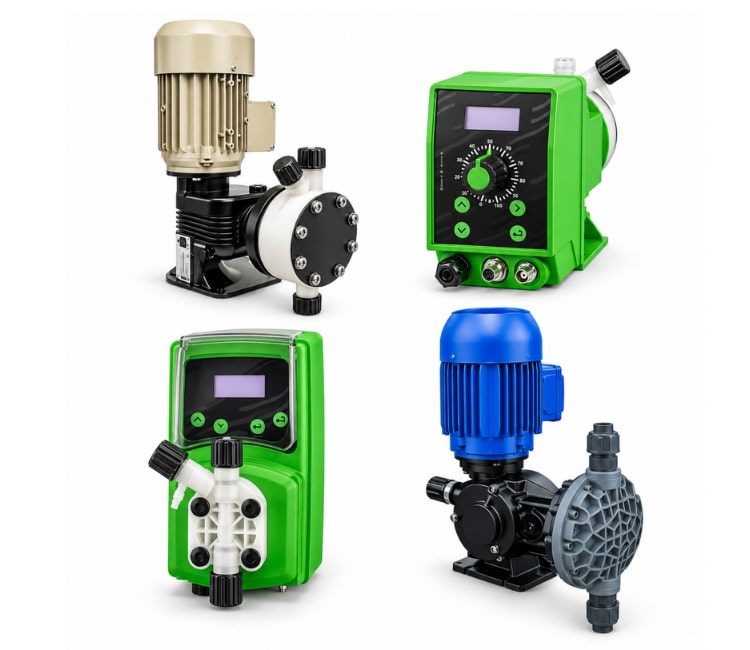
A chemical dosing pump, also called a metering pump, injects a small, controlled amount of chemical into water or process liquid. Each stroke moves a set volume, so flow can be set and repeated. ETP, WTP, boiler and cooling tower plants use it to dose coagulants, acids, alkalis, polymers and disinfectants.
A dosing pump is not a transfer pump. A transfer pump moves liquid in bulk, such as a drum and container pump, while a dosing pump delivers precise small flows. See the EMEC and SEKO pages for brand details.
- Solenoid pumps for small flows and electronic control
- Motor-driven diaphragm pumps for larger flows and higher pressure
- Wetted parts in PVC, PP, PVDF, PTFE, SS-304 and SS-316
- Installation and after-sales support in Bangladesh
Chemical Dosing Pump Specifications
- Solenoid Driven Pump
- 1 ~ 16 L/h (about 0.27 L/min), 1 ~ 20 bar (about 0.1 ~ 2 MPa)
- Motor Driven Diaphragm Pump
- 1 ~ 1000 L/h (about 1 m³/h), 1 ~ 100 bar (about 0.1 ~ 10 MPa)
- Wetted Part Material
- PVC, PP, PVDF, PTFE, SS-304, SS-316
- Liquids
- Normal chemicals, corrosive liquids, hot liquids and other substances
- Application
- Waste water, boiler water, cooling tower, high-viscosity liquids
- Industries
- Chemical, textile, pharmaceutical, food and beverage
- Brand
- EMEC, SEKO
- Origin
- Italy
Flow, pressure, material and control options depend on the model you select. Send us the chemical, dose rate and back pressure and our engineers will confirm the right pump.
How Does a Dosing Pump Work?
- Diaphragm Pulls BackThe drive moves the diaphragm back and creates suction in the pump head.
- Chemical Is Drawn InA suction check valve opens and lets chemical in from the tank.
- Diaphragm Pushes ForwardThe suction valve closes and the diaphragm pushes a set volume out.
- Chemical Is InjectedThe discharge valve opens and the dose enters the pipe or tank at the injection point.
- Dose Is AdjustedStroke length, stroke rate or a signal from a pH analyzer or flow meter sets the flow.
Which Pump Head Material for Which Chemical?
Wrong material is a common cause of leaks and pump head damage. Match it to the chemical, strength and temperature.
| Material | Commonly Used For | Note |
|---|---|---|
| PVC | Sulfuric acid, PAC, caustic soda, aluminium chloride | More sensitive to heat than PP or PVDF |
| PP | Caustic soda, hydrochloric acid, many general chemicals | Often rated roughly 4 to 60 °C |
| PVDF | Sodium hypochlorite, stronger acids, chlorine | Wider temperature range, also used in food-grade duty |
| PTFE | Diaphragms and parts for most acids and solvents | Very wide chemical resistance |
| SS-316 | Dilute sulfuric acid, phosphoric acid, food and beverage | Resistance depends on acid strength and temperature |
| SS-304 | Mild, non-chloride liquids | Generally less corrosion resistant than SS-316, so check the datasheet |
General guidance only. Always check a chemical compatibility chart for your exact chemical, strength and temperature, or ask our engineers.
Key Benefits
Correct dosing saves chemical and protects the treatment process that follows.
- Repeatable dose: each stroke delivers a set volume, so flow can be set and repeated
- Two drive types cover small flows of 1 L/h up to 1000 L/h
- Pressure up to 20 bar on solenoid and 100 bar on motor-driven pumps
- Six wetted materials to suit acids, alkalis, hypochlorite and other chemicals
- Can link with a pH analyzer or flow meter for automatic dosing
- Local engineering and after-sales support from Techno Bangla
Which Industries Use Chemical Dosing Pumps?
Chemical processing, water treatment and pharmaceutical plants are the main users of metering pumps in Bangladesh.
| Industry | What Is Dosed | Why Dosing Matters |
|---|---|---|
| Textile and dyeing ETP | PAC or alum, polymer, caustic soda, sulfuric acid | Biological treatment alone removes little colour, so chemical dosing stays central in ETP plants |
| Water treatment (WTP) | Sodium hypochlorite, coagulant, pH chemicals | Disinfection and clarification need steady, small doses in a water treatment plant |
| Boiler and cooling tower | Scale and corrosion inhibitors, biocides, acid | Inhibitors are usually dosed in proportion to make-up water. See our cooling tower |
| Pharmaceutical | pH adjusters, disinfectants, process chemicals | Tight pH and dose control supports process quality and discharge limits |
| Food and beverage | Cleaning and sanitising chemicals, pH control | PVDF and SS-316 wetted parts suit hygiene-critical duty |
| Chemical industry | Process additives and neutralising agents | Accurate feed cuts waste of costly chemicals |
| Sewage treatment (STP) | Disinfectant, coagulant, polymer | Supports discharge quality in an STP |
- ETP
- WTP
- STP
- Boiler Water
- Cooling Tower
- Textile
- Pharmaceutical
- Food & Beverage
- Chemical Plant
How to Calculate the Dosing Pump Size
A simple mass balance gives the flow you need in litres per hour.
The Formula
- Pump flow (L/h) = water flow (m³/h) × dose (mg/L) ÷ chemical strength (g/L)
- Water flow is the stream you treat, in m³/h
- Dose comes from a jar test or supplier advice, in mg/L
- Strength is the active chemical per litre of solution, in g/L
Worked Example
- ETP flow 50 m³/h and a PAC dose of 60 mg/L (an example dose from a published textile study)
- 50 × 60 = 3000 g/h, or 3 kg/h of PAC
- With a 10% solution, which is about 100 g/L, the pump flow is 30 L/h
- 30 L/h is above the solenoid range, so a motor-driven pump fits. Add a margin and check back pressure
The dose is an example only. Real doses change with effluent, so run a jar test. Under-dosing leaves pollutants in the water, and wrong dosing can upset the biological stage that follows.
Which Dosing Pump Fits Your Plant?
Choose a Solenoid Pump When
- The dose is small, up to 16 L/h
- Pressure at the injection point is up to 20 bar
- You need electronic control or flow-proportional dosing
- Space is tight and a compact unit helps
- You dose polymer, disinfectant or inhibitor
Choose a Motor-Driven Pump When
- The dose is larger, up to 1000 L/h
- Back pressure is high, up to 100 bar
- The pump runs continuously for many hours
- You want a simple mechanical design
- You dose coagulant, acid or caustic in a larger ETP
How to Choose the Right Dosing Pump
Share these details with our engineers and we will recommend a suitable model and material.
- Chemical and strength. Name the chemical and concentration. This decides the head and diaphragm material.
- Dose rate. Give the flow in L/h, or the water flow and dose so we can calculate it.
- Back pressure. Tell us the pressure at the injection point in bar, including pipe losses.
- Control method. Manual stroke setting, pulse input, 4-20 mA, or pH control with an online analyzer.
- Temperature and viscosity. Hot Bangladesh summers and warm effluent narrow the safe range of plastics, and thick liquids need a suitable pump head.
Frequently Asked Questions
What is the difference between a solenoid and a motor-driven dosing pump?
Choose by dose rate, pressure and control. Solenoid pumps (1 to 16 L/h, up to 20 bar here) are compact and give electronic stroke and pulse control. Motor-driven diaphragm pumps (1 to 1000 L/h, up to 100 bar) suit higher flow, high pressure and long running hours.
Which pump head material should I choose?
Match the wetted material to the chemical. PVC or PP suit caustic soda and PAC, PVDF suits sodium hypochlorite and stronger acids, PTFE diaphragms resist most chemicals, and SS-316 suits dilute sulfuric and phosphoric acid. Strength and temperature change the answer, so check a compatibility chart or send us your chemical.
How do I calculate the dosing pump size I need?
Multiply water flow in m3/h by dose in mg/L to get grams per hour, then divide by chemical strength in g/L to get litres per hour. For 50 m3/h at 60 mg/L with a 10% solution, you need about 30 L/h. Confirm the dose with a jar test.
Is a dosing pump the same as a metering pump?
Yes. Dosing pump, metering pump and chemical feed pump are different names for the same positive displacement pump that delivers a set volume per stroke. “Chemical dosing pump” simply means it injects chemicals. Techno Bangla supplies EMEC and SEKO versions for water and wastewater plants.
What is the difference between EMEC and SEKO dosing pumps?
EMEC and SEKO are separate Italian manufacturers, both based around Rieti. Company profiles describe EMEC as a maker of electronic metering pumps and instruments for water treatment, founded in 1982, and SEKO as a larger group founded in 1976 that also builds peristaltic pumps and dosing skids. The right brand depends on your dose rate, pressure and control needs.
How much does a chemical dosing pump cost in Bangladesh?
Price depends mainly on capacity in L/h, working pressure, head and diaphragm material, drive type and control features. Small solenoid pumps cost far less than motor-driven pumps built for higher flow and bar. For an exact figure, send your chemical, dose rate and back pressure and we will quote the matching EMEC or SEKO model.
Can I use a normal transfer pump to dose chemicals?
Not for accurate dosing. A centrifugal or transfer pump moves liquid in bulk and its flow changes with pressure, so it cannot hold a small, repeatable dose. A dosing pump delivers a fixed volume per stroke against back pressure. Use a transfer pump, such as a drum pump, only to fill the chemical tank.
How accurate is a diaphragm dosing pump?
Accuracy depends on the pump type and your system. Technical papers quote about ±2% for mechanical diaphragm pumps, and electronic pumps can be tighter, but back pressure, viscosity and worn check valves all shift real flow. Check the datasheet of your model and verify output with a calibration column during commissioning.
How long does a chemical dosing pump last?
With compatible chemicals and routine care, a quality dosing pump commonly lasts 10 to 15 years, according to one UK distributor. The wearing parts are the diaphragm, valve balls and seats, and seals, which are replaced on a schedule that depends on chemical and duty. Keep a spare kit and log run hours.
How do I automate pH dosing with a dosing pump?
Place a pH probe or online analyzer in the tank after the injection point, then send its mA or pulse signal to the pump so the dose rises and falls with pH. Leave enough mixing distance so the probe reads a mixed sample, and calibrate the probe regularly.