Electromagnetic Flow Meter Supplier in Bangladesh
Your ETP outlet is only as honest as its meter. Our electromagnetic flow meters read conductive liquids with no moving parts, from clean water to sludge. They come in 25–600 mm sizes with rubber or PTFE liners and a digital display with remote monitor, backed by installation support from Techno Bangla Creation.

What Is an Electromagnetic Flow Meter?
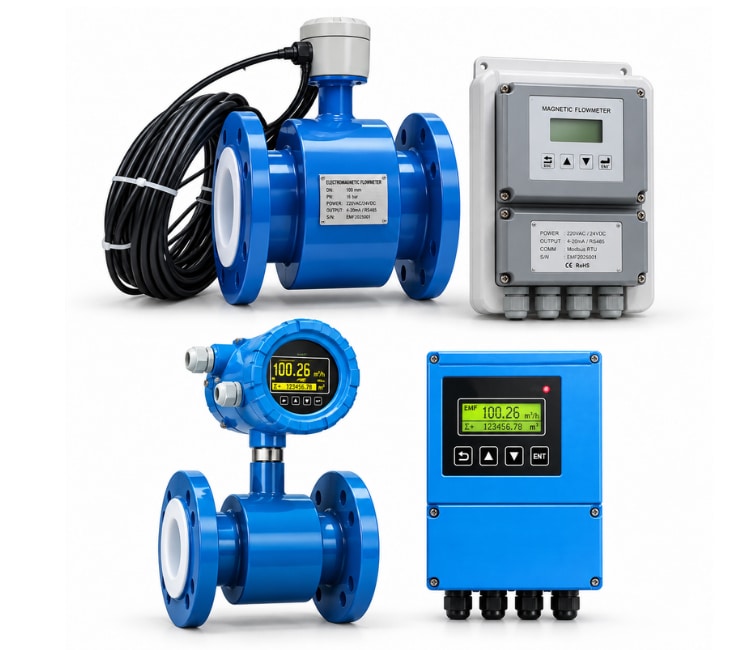
An electromagnetic flow meter, or magmeter, measures the flow of electrically conductive liquids using Faraday's law of induction. Coils create a magnetic field across the pipe, and electrodes pick up a voltage that rises with liquid velocity. It has no moving parts, so it suits water, wastewater and sludge lines.
A magmeter is not a vortex or turbine meter. It reads liquid velocity from the induced voltage, so the liquid must conduct electricity and the pipe must run full. For steam, gas and air, see our vortex flow meter. For diesel and oil, see the oval gear flow meter.
- Measures conductive liquids such as water, effluent and chemicals
- No moving parts and no obstruction in the pipe
- Digital display with remote monitor and 10 m cable as listed
- Rubber or PTFE lining options
Electromagnetic Flow Meter Specifications
- Type
- Electromagnetic (magmeter) digital water flow meter
- Display
- Digital display with remote monitor
- Size
- 25 ~ 600 mm (about 1 ~ 24 inch)
- Lining Material
- Rubber or PTFE
- Temperature
- 60 ~ 100 °C as listed. The limit depends on the liner, so confirm it for your model.
- Cable
- 10 m cable included
- Brand
- Smart Measurement Co, Ltd, TECHANGE
- Origin
- USA, China
Electrode material, accuracy, outputs and pressure rating depend on the model. Send us your pipe size and liquid and our engineers will confirm them on the datasheet.
How Does an Electromagnetic Flow Meter Work?
- Coils Create a FieldCoils around the flow tube produce a magnetic field across the pipe.
- Liquid Cuts the FieldConductive liquid flows through the field at right angles.
- Voltage Is InducedMoving liquid generates a small voltage. Higher velocity gives higher voltage.
- Electrodes Pick It UpTwo electrodes touch the liquid through an insulating liner and sense the voltage.
- Transmitter Shows FlowThe converter turns velocity into flow rate and total on the digital display.
Key Benefits of Electromagnetic Flow Meters
Accurate flow data helps you control chemical dosing, water use and discharge records.
- No moving parts, so wear and routine maintenance stay low
- Full-bore tube blocks nothing and adds almost no pressure loss
- Reading is largely unaffected by density, temperature, pressure and viscosity
- Typical accuracy of about ±0.2 to 0.5% of reading, as reported by makers
- Copes with slurries, sludge and dirty effluent when the liner is chosen well
- Local engineering and after-sales support from Techno Bangla
When Should You Choose a Magmeter?
Choose an Electromagnetic Meter When
- The liquid is water, effluent, sludge or a conductive chemical
- The pipe runs full and flow is steady or varies widely
- You need low pressure loss and no moving parts
- Solids, fibres or dirt make other meters unreliable
- You need readings for dosing control or discharge records
Choose Another Meter When
- The medium is steam, gas or air. Use a vortex or thermal gas meter.
- The liquid is diesel or oil. Use an oval gear meter.
- Flow runs in an open drain or channel. Use an open channel flow meter.
- The liquid is demineralised or very pure water with almost no conductivity
- The pipe is often only partly full
Where Are Electromagnetic Flow Meters Used?
Any full pipe carrying a conductive liquid.
- ETP Inlet and Outlet
- WTP Raw and Treated Water
- STP
- Textile and Dyeing
- Pharmaceutical
- Food and Beverage
- Chemical Dosing Lines
- Sludge Lines
- Cooling Water
- Irrigation
How to Choose the Right Electromagnetic Flow Meter
Share these details with our engineers and we will recommend a suitable model and size.
- Liquid conductivity. Makers quote a minimum of about 5 µS/cm, and about 20 µS/cm for demineralised water. Treated and raw water usually pass. Pure RO or DI water does not.
- Liner and electrodes. Rubber suits water and abrasive solids. PTFE suits chemicals and higher temperatures. Check the chemistry, oils and grease before you pick.
- Pipe size and velocity. Many makers advise about 1 to 5 m/s, and under 2 m/s for slurries. Size the meter to the flow, not always to the pipe.
- Installation. Keep the tube full, ground the liquid, and follow the straight-run advice on the datasheet. In flood-prone pits, ask for an IP68 sensor.
- Outputs and display. Ask for 4-20 mA, pulse or Modbus if you use a PLC or SCADA, and a stable power supply in areas with voltage swings.
Frequently Asked Questions
Why does an electromagnetic flow meter need grounding?
The signal the electrodes read is very small. The liquid has to share the same electrical reference as the meter, and grounding rings or grounding electrodes provide it. This matters most in plastic or lined pipe. Poor grounding shows up as noisy, drifting readings or false empty-pipe alarms.
Can it measure RO water, DI water, oil or steam?
No. The meter needs a conductive liquid. Most units need a minimum conductivity of a few µS/cm, and some makers quote 20 µS/cm. Ultra-pure water, oils, hydrocarbons, steam and gas fall below that. Tell us your liquid and we will suggest a better-matched meter.
What happens if the pipe is not full?
The reading becomes unreliable, or the meter shows an empty-pipe alarm. The sensor must stay filled, so install it where the pipe runs full, such as a vertical run with upward flow. For channels or part-full lines, an open channel meter is the right tool.
How accurate is it, and what can spoil the reading?
Typical accuracy is about ±0.5% of reading, and some makers quote ±0.2%. In practice, accuracy depends on a full pipe, good grounding, the straight run before the sensor, air bubbles, electrode coating and nearby electrical interference. Sludge and sticky effluent can foul electrodes, so plan a cleaning check.
Can it connect to a PLC or SCADA, and how far can the display sit?
Meters in this class commonly offer 4-20 mA, pulse and RS485/Modbus outputs. Our listed units come with a digital display, a remote monitor and a 10 m cable. Tell us your control system and we will confirm the outputs for your model.
Why does it cost more than a mechanical water meter?
A mechanical meter counts a spinning rotor, so the rotor wears and can clog in dirty liquid. An electromagnetic meter has no moving parts and no obstruction in the pipe. It handles effluent and sludge and gives digital outputs. You pay more up front for lower maintenance on dirty lines. Send your pipe size and liquid, and we will quote a meter for your line.