ALGO Suction Centrifugal Pump: End-Suction Pump Supplier in BD
ALGO ESAR suction centrifugal pump (end-suction, from India) for filter feed, water transfer and cooling duty in ETP, WTP and industry, supplied with sizing help and after-sales support by Techno Bangla Creation.
What Is a Suction Centrifugal Pump?
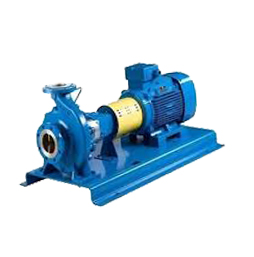
A suction centrifugal pump draws liquid into the centre of a spinning impeller, which throws it outward and builds the pressure that pushes it through the pipe. The ALGO ESAR is an end-suction design, so liquid enters along the shaft line and leaves from the top. It moves clean or lightly contaminated water at high flow.
Like most end-suction pumps it is not self-priming, so the casing must be full of liquid before start. It is not a sludge pump or a dosing pump. For solids see our self-priming open impeller pump.
- Single-stage design for medium to high flow at moderate head
- Used for filter feed, water transfer and cooling water duty
- Cast iron or stainless steel construction options on the series
- Sizing help and after-sales support in Bangladesh
ALGO Suction Centrifugal Pump Specifications
- Brand
- ALGO
- Origin
- India
- Series
- ESAR (end suction)
- Capacity
- 10 ~ 720 m³/hr
- Max. Liquid Temperature
- 40 °C ~ 90 °C, depending on seal and construction
- Motor Power
- 18.5 kW / 25 HP
- Motor Speed
- 2900 rpm
- Protection
- IP 55
- Head
- Maker lists up to 110 m for the ESAR/ESAM family, set by model and impeller
- Material Options
- Cast iron or SS 304 / 410 / 316 impeller, SS 304 / 316 casing
- Shaft Seal Options
- Gland packing or mechanical seal
- Mounting Options
- Electric motor or engine, with base plate
Capacity, temperature, motor power, speed and protection are from our product listing. Head and option rows come from the ALGO maker catalogue for the ESAR/ESAM series. Ask us for the model datasheet and performance curve before you order.
How Does a Suction Centrifugal Pump Work?
- Casing Is FilledThe pump casing and suction pipe are full of liquid, a step called priming.
- Motor Spins the ImpellerThe motor turns the impeller at about 2900 rpm on a 50 Hz supply.
- Liquid Is Thrown OutwardVanes fling liquid from the centre to the rim, and fresh liquid rushes in at the suction eye.
- Volute Builds PressureThe spiral casing slows the liquid and turns speed into pressure.
- Liquid Leaves the PumpFlow exits the discharge to a filter, tank, cooling tower or process line.
What Three Checks Decide the Right Pump?
Most pump problems start with a poor match between pump and duty. Check these three first.
1. Duty Point
- Know the flow in m³/hr and the total head in metres
- Total head is static lift plus pipe friction plus any pressure needed
- Pick a pump whose curve puts your duty near its best efficiency point
- A common guide is 75 to 110% of best-efficiency flow
2. Suction Conditions
- Net positive suction head (NPSH) available must exceed what the pump requires
- A margin of about 1 to 1.5 m is a common guide
- Too little causes cavitation, which damages impellers and seals
- Keep the pump at or below liquid level and the suction pipe short
3. Liquid and Materials
- Say whether the liquid is clean, muddy, acidic or salty
- State the temperature and any solids
- Choose cast iron or stainless steel to suit the liquid
- Choose gland packing or mechanical seal for the duty
How Do You Size a Centrifugal Pump Motor?
For water, shaft power in kW is about flow in m³/hr times head in metres, divided by 367 times pump efficiency. Add a margin for the motor.
- Example 1
- 100 m³/hr at 30 m head, pump efficiency 70%
- Example 1 Power
- 100 × 30 ÷ (367 × 0.70) = about 11.7 kW. With a 15% margin, about 13.4 kW, so choose a 15 kW motor.
- Example 2
- 200 m³/hr at 20 m head, pump efficiency 75%
- Example 2 Power
- 200 × 20 ÷ (367 × 0.75) = about 14.5 kW. With a 15% margin, about 16.7 kW, so choose an 18.5 kW motor.
Illustrative arithmetic. Real efficiency comes from the pump curve at your duty point. Speed also matters: flow changes with speed, head with speed squared and power with speed cubed. Running at 80% speed on a variable frequency drive uses about half the power, which is why a drive can save energy.
Key Benefits of an End-Suction Centrifugal Pump
A simple single-stage pump that moves a lot of water for its size.
- High flow capacity, with our listing covering 10 to 720 m³/hr
- Simple single-stage design with easy access above ground
- Cast iron or stainless steel impeller and casing options to suit the liquid
- Choice of gland packing or mechanical seal, and motor or engine drive
- Variable frequency drive control can cut energy at part load
- Local sizing help and after-sales support from Techno Bangla
Is an End-Suction Pump Right for Your Plant?
Choose an End-Suction Pump When
- The liquid is clean or only lightly contaminated
- You need medium to high flow at moderate head
- The pump can sit at or below the liquid level
- You feed filters, a cooling tower or a transfer line
- You want easy upkeep above ground
Look at Other Options When
- The liquid carries solids, rags or sludge. Use a self-priming open impeller pump.
- The pump sits in a pit. Use a submersible sewage pump.
- The liquid must be lifted from below the pump without filling the casing first
- You need very high head at low flow, where a multistage pump suits better
- You are dosing chemicals. See dosing pumps.
Where Are Suction Centrifugal Pumps Used?
Any plant that moves clean or lightly contaminated water at good flow.
- ETP Filter Feed
- WTP Filter Feed
- Clarified Water Transfer
- Cooling Tower Circulation
- Chilled Water Loops
- Process Water Supply
- Textile and Garment Factories
- Food and Beverage
- Irrigation
- Building Water Supply
How to Choose a Suction Centrifugal Pump
Share these details with our engineers and we will recommend a pump, motor and seal for your duty.
- Flow and head. Required flow in m³/hr and total head in metres, including pipe friction and any pressure needed at the end.
- Liquid. Type, temperature, pH and any solids, so we can choose materials and seal.
- Suction condition. Flooded suction or lift, pipe length and size, so NPSH can be checked.
- Drive and power. Electric motor or engine, three-phase 50 Hz supply, and any need for a variable frequency drive.
- Mounting and extras. Base plate, coupling, flow meter and pipework. See our flow meters to track duty.
Frequently Asked Questions
Does the ALGO end-suction pump come with a motor?
The ALGO ESAR/ESAM series is built as a bare-shaft pump, so the motor or engine is added to suit your site, usually on a base plate. Tell us your power supply and we will match the drive to the pump curve.
What is the ALGO ESAR series pump?
ALGO ESAR is a series of bare-shaft end-suction centrifugal pumps from ALGO, India. The maker lists options for cast iron or stainless steel impellers and casings, gland packing or mechanical seals, and motor or engine mounting. Our listing covers 10 to 720 m³/hr with an 18.5 kW motor at 2900 rpm.
What is the difference between an end-suction and a self-priming pump?
An end-suction pump needs its casing filled with liquid before it starts and works best with the liquid at or above pump level. A self-priming pump can clear air and lift liquid from below, and open-impeller types handle solids. Choose end-suction for clean water at high flow, and self-priming for effluent or sludge.
How do I choose the right pump size and motor?
Start with flow in m³/hr and total head in metres. For water, shaft power in kW is roughly flow times head divided by 367 times pump efficiency. Add a margin of about 15 percent and round up to a standard motor. Then check the pump curve so your duty sits near its best efficiency point.
What is NPSH and why does it matter?
NPSH is net positive suction head, the pressure margin at the pump inlet that keeps liquid from boiling into vapour bubbles. If NPSH available falls below what the pump requires, cavitation occurs, causing noise, lost flow and damage to impellers and seals. A margin of about 1 to 1.5 metres is a common design guide.
Can a suction centrifugal pump handle sewage or sludge?
A standard end-suction pump with a closed impeller is meant for clean or lightly contaminated water, and solids can clog or wear it. For sludge, effluent with solids or sewage, use a self-priming open impeller pump or a submersible sewage pump. Tell us about your liquid and we will recommend the right type.
What is the price of an ALGO suction pump in Bangladesh?
Price depends on the model, flow, head, motor power, materials, seal type and quantity. A 20 HP pump and a 5 HP pump are priced very differently, and stainless steel costs more than cast iron. A duty-specific quotation is more reliable than a general figure, so send your flow and head and we will reply with a free quotation.
How can I get a quotation for an ALGO suction pump?
Send your required flow in m³/hr, total head in metres, liquid type and temperature, and suction conditions by phone or email. Our engineers will recommend a suitable ALGO model or an alternative, with motor and seal options, and reply with a free quotation for your ETP, WTP or other water treatment equipment.