Techange Ultrasonic Flow MeterSupplier in Bangladesh
Techange clamp-on ultrasonic flow meter for clean water and waste water lines. Measure flow from outside the pipe, with no cutting and no shutdown, supplied with installation and after-sales support by Techno Bangla Creation.
What Is a Techange Ultrasonic Flow Meter?
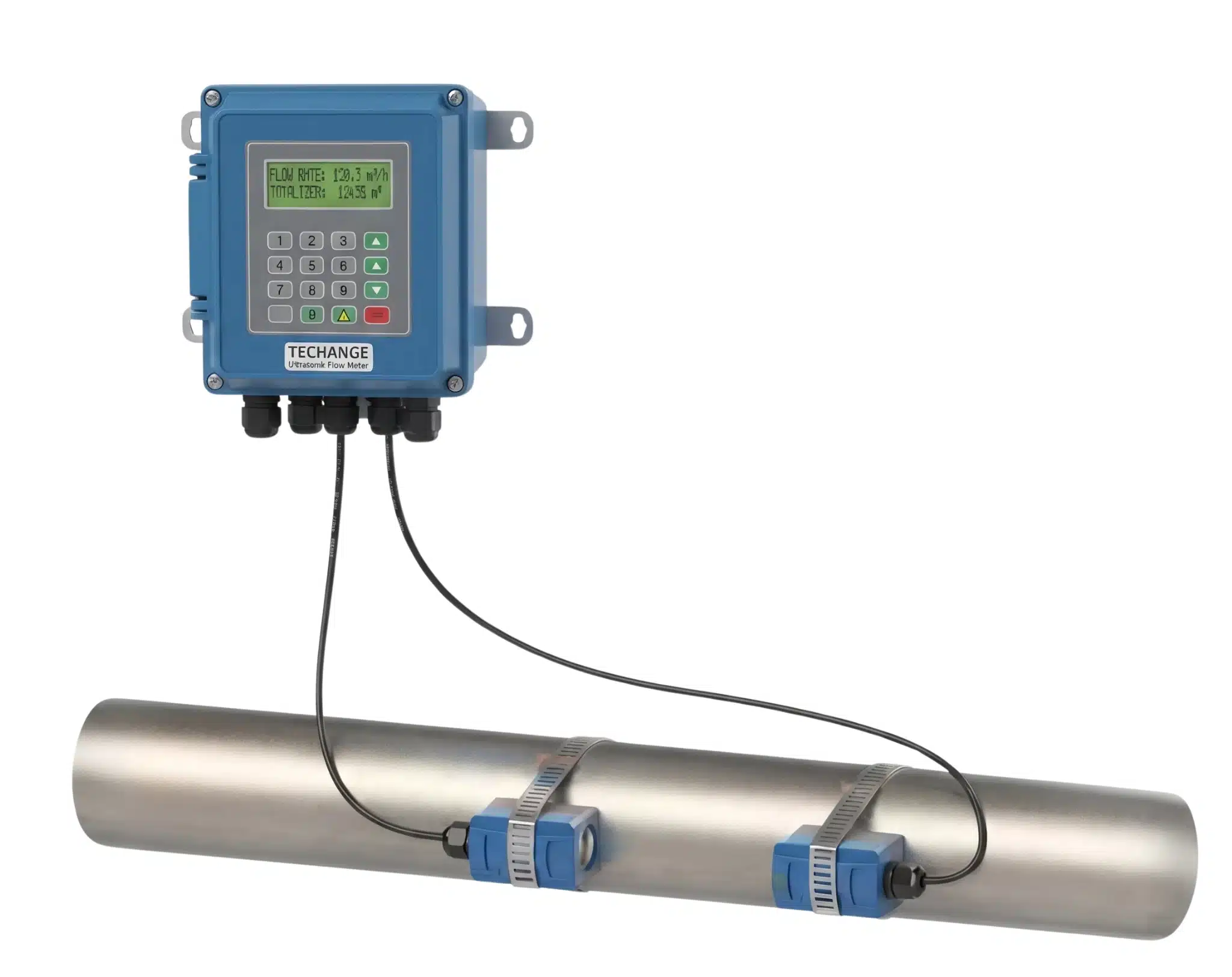
A Techange ultrasonic flow meter measures how much liquid moves through a pipe by sending ultrasonic signals through the pipe wall. Its clamp-on sensors strap onto the outside of the pipe, so nothing touches the liquid, the line is never cut and the process keeps running.
The meter has a wall-mounted monitor with a 2 × 20 character backlit LCD and a 4-20 mA output. Its sensors work on carbon steel, stainless steel, cast iron, PVC, fibre and cement pipes from 25 to 6000 mm. It is not a pressure gauge. For gas lines, see our thermal gas flow meter.
- Accuracy of ±1% and flow velocity of 0 to 7 m/s, as listed
- Monitor rated IP67 and sensor rated IP68
- 4-20 mA output for PLCs and control systems
- Installation and after-sales support in Bangladesh
Why Do Bangladeshi Factories Need Flow Measurement?
Water is getting scarcer and effluent rules are getting stricter. You cannot manage either without a flow number.
- ETP design and inspection start with flow. The Department of Environment's ETP assessment guide asks each textile ETP scheme to state its method of flow measurement at the final outlet, and to size every unit in m³/day and m³/hour.
- Online monitoring is coming. A GIZ-supported pilot linked monitoring devices at six industries to a DoE online ETP system, and BSS reported in July 2026 that the government is moving ETPs of Buriganga-polluting industries under online monitoring.
- Groundwater is under pressure. Most industrial water in Bangladesh is pumped from underground, and the water table in hubs such as Gazipur and Savar has been reported falling by 2 to 3 m a year. Metering each line shows where water is lost.
- Wet processes use a lot. Textile studies report about 164 litres of groundwater per kg of cotton fabric processed. A Dhaka EPZ study also stressed precise flow measurement for fair wastewater tariffs and sound system design.
Techange Ultrasonic Flow Meter Specifications
- Brand
- Techange
- Type
- Clamp-on ultrasonic flow meter
- Measures
- Flow, volume and level (as listed)
- Flow Rate
- ± 0 ~ 7 m/s
- Accuracy
- ± 1%
- Pipe Diameter
- 25 ~ 6000 mm
- Pipe Material
- Carbon steel, stainless steel, cast iron, PVC, fibre, cement and similar
- Fluid Temperature
- 30 ~ 160 °C (standard)
- Output
- 4 ~ 20 mA
- Display
- 2 × 20 character LCD with backlight
- Monitor
- Standard wall mounted
- Monitor Protection
- IP67
- Sensor Protection
- IP68
- Dimension (as listed)
- 64 × 39 × 44 mm
- Power Supply
- 220 V
- Power Consumption
- 1.5 W
- Application
- Clean water, waste water
- Origin
- China
Real-world accuracy depends on correct pipe data, a full pipe, clean sensor contact and enough straight pipe. Send us your pipe size, material and liquid and our engineers will confirm the right setup.
Clamp-on Ultrasonic vs Electromagnetic vs Mechanical Meter
All three can meter water. They differ in how they install, what they need from the liquid and how they age.
| Feature | Clamp-on Ultrasonic | Electromagnetic (Inline) | Mechanical (Analog) |
|---|---|---|---|
| Installation | Strap on outside the pipe. No cutting, no shutdown | Pipe is cut and a flanged spool is fitted | Pipe is cut and the meter is threaded or flanged in |
| Pressure loss | None | Very low, full bore | Noticeable, grows with flow |
| Liquid needs | Clean to moderately dirty liquid, with few bubbles. Conductivity does not matter | Must be electrically conductive | Clean water, as grit wears the parts |
| Moving parts | None, and nothing touches the liquid | None | Yes, and they wear |
| Pipe size range | 25 ~ 6000 mm with the Techange clamp-on sensors | Wide, but cost climbs fast with size | Common in small to medium sizes |
| Accuracy (typical) | Techange states ±1% | Often 0.5% or better in a full, conductive line | Drifts as the parts wear |
| Best fit | Retrofits, big pipes, ETP and effluent lines, checking an existing meter | New lines where cutting is easy and billing-grade accuracy matters | Simple, low-cost water totalising |
How Does a Clamp-on Ultrasonic Flow Meter Work?
- Sensors Go on the PipeA pair of sensors is clamped on the pipe wall with coupling gel, at a spacing set from the pipe data.
- Pulses Cross the LiquidEach sensor sends an ultrasonic pulse through the wall and the liquid to the other one.
- Monitor Times the DifferenceA pulse travelling with the flow arrives slightly sooner than one travelling against it. The monitor measures that gap.
- Velocity Becomes FlowUsing the pipe size and liquid you enter, it turns velocity into flow rate and a running total.
- Display and OutputThe backlit 2 × 20 LCD shows the reading, and the 4-20 mA output sends the signal to your PLC or recorder.
Key Benefits of the Techange Ultrasonic Flow Meter
A meter you can fit in an hour without stopping the plant is worth more than a perfect one you cannot install.
- No pipe cutting, no shutdown and no pressure loss with clamp-on sensors
- ±1% stated accuracy for clean water and waste water
- IP67 monitor and IP68 sensor, built for wet plant rooms and pump houses
- Pipes from 25 to 6000 mm in carbon steel, stainless steel, cast iron, PVC, fibre or cement
- 4-20 mA output and a backlit LCD for easy control-room and field use
- Low power use, about 1.5 W on a 220 V supply
Is a Clamp-on Ultrasonic Meter Right for Your Line?
Choose Clamp-on When
- You cannot stop production or cut the pipe
- The pipe is large, from 300 mm up, where an inline meter costs a lot
- You want to check or replace a doubtful existing meter
- The liquid is corrosive, hot or dirty, so a probe in the stream would not last
- You need to meter an ETP outlet or a cooling loop quickly
Think Twice When
- The pipe often runs part-full, as in a gravity drain. Use a flume or weir with a level sensor instead
- The wall is heavily scaled, rusted or lined with a poor sound path
- The liquid carries a lot of air or gas bubbles
- There is almost no straight pipe before or after the meter
- You need legal billing-grade accuracy
Where Is the Techange Ultrasonic Flow Meter Used?
Any full pipe carrying clean water or waste water that you want to measure without opening it.
- ETP Outlet Flow
- STP Inlet and Outlet
- WTP and RO Feed Water
- Boiler Feed Water
- Chilled and Cooling Water
- Textile and Dyeing
- Pharmaceutical
- Food and Beverage
- Power Plant Cooling
- Building Water Supply
- Raw Water Intake
How to Choose the Right Techange Ultrasonic Flow Meter
Share these details with our engineers and we will confirm the meter and sensors for your line.
- Pipe size, material and wall. Give the outside diameter (25 to 6000 mm), the material (carbon steel, stainless steel, cast iron, PVC, fibre, cement) and any lining.
- Liquid and temperature. The standard fluid temperature is listed as 30 to 160 °C. Tell us your real operating temperature so we can confirm the sensor.
- Full pipe and straight run. The pipe must be full. As a rule of thumb, allow about 10 pipe diameters of straight pipe before the meter and 5 after, and avoid pump outlets and partly open valves.
- Output and power. The 4-20 mA output suits a PLC or recorder. The wall-mounted monitor needs a 220 V supply and uses about 1.5 W, so mount it near the pipe.
- Pair with water quality. Pair flow data with an online analyzer for pH or chlorine on the same line.
Frequently Asked Questions
What is a Techange ultrasonic flow meter?
A Techange ultrasonic flow meter measures liquid flow by sending ultrasonic signals through the pipe wall from sensors fixed on the outside. Nothing touches the liquid, so there is no pipe cutting, no shutdown and no pressure loss. Techno Bangla Creation supplies the clamp-on type for clean water and waste water.
Which type of ultrasonic flow meter do you supply?
We supply a Techange clamp-on ultrasonic flow meter with a standard wall-mounted monitor, a 2 × 20 character backlit LCD and a 4-20 mA output. The monitor is rated IP67 and the sensor IP68. It runs on 220 V and uses about 1.5 W. Ask our engineers if you need another type.
How accurate is the Techange ultrasonic flow meter?
Techange lists an accuracy of ±1% and a flow velocity range of 0 to 7 m/s. Field results depend on correct pipe data, a full pipe, good sensor contact and enough straight pipe. We help set up the meter so it performs close to its rating.
Can it measure ETP effluent and waste water?
Yes, clean water and waste water are the listed applications. The pipe must run full. For a gravity drain or open channel, a flume or weir with a level sensor is the better choice. Send us your line details and our engineers will confirm the setup.
Do I need to stop production to install it?
No. Clamp-on sensors fix to the outside of the pipe with coupling gel, so you do not need to cut off the water or cut the pipe, and there is no pressure loss. You only need clean pipe wall contact, correct pipe data and a place for the wall-mounted monitor.
What pipe sizes and materials can it measure?
The meter covers pipe diameters from 25 to 6000 mm. It works on carbon steel, stainless steel, cast iron, PVC, fibre and cement pipes, with a standard fluid temperature listed as 30 to 160 °C. Send us your pipe size, material and liquid so we can confirm the sensors.
How much does an ultrasonic flow meter cost in Bangladesh?
Price depends on pipe size, material, temperature range and options. For context, small inline electromagnetic meters were listed on Bangladeshi marketplaces at roughly ৳45,000 to ৳65,000 in mid-2026, and they still need the pipe cut. Send your pipe details and we will quote the full set.
What information do you need for a quotation?
Send the pipe outside diameter, pipe material and lining, liquid type, temperature, whether the pipe runs full, and where you can mount the monitor. Tell us the output you need, such as 4-20 mA. We reply with a free quotation.