Air DiffuserSupplier in Bangladesh
Trundean fine bubble and coarse bubble air diffusers from Taiwan for ETP, WTP and STP aeration, supplied with installation and after-sales support by Techno Bangla Creation.
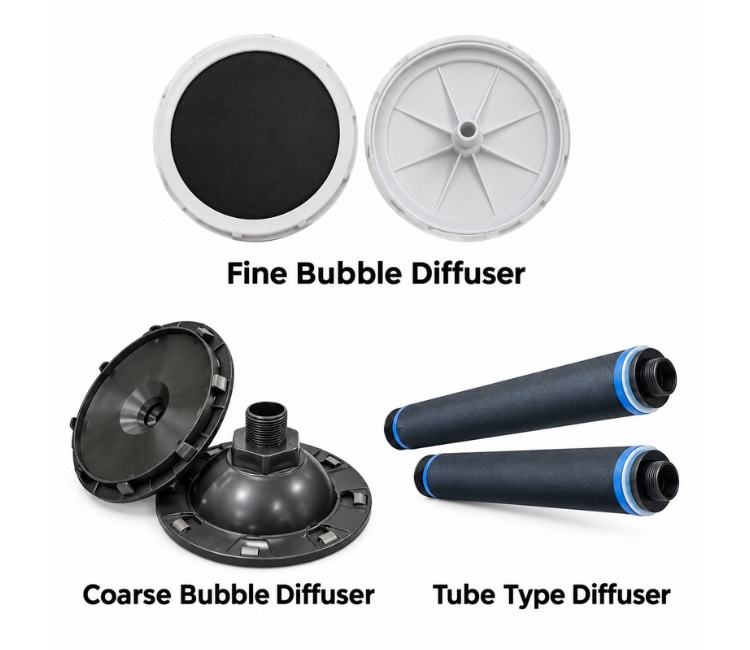

What Is an Air Diffuser?
An air diffuser is an aeration device, usually shaped like a disc or tube, that releases compressed air as bubbles at the bottom of a wastewater tank. The bubbles pass oxygen into the water so aerobic bacteria can break down pollution. In ETP, WTP and STP plants, diffusers connect to a blower through an air pipe grid.
A diffuser is not a blower. The blower makes the air and the diffuser spreads it through the tank. For the air supply, see our turbo blower and Roots air blower pages.
- Fine bubble discs, fine bubble tubes and coarse bubble discs
- Sizes from 150 mm to 1000 mm
- Suited to ETP, WTP, STP, municipal and fisheries use
- Installation and after-sales support in Bangladesh
Air Diffuser Specifications
- Type
- Fine bubble and coarse bubble air diffusers (disc and tube)
- Fine Bubble (Disc)
- 250 mm (10 in) and 300 mm (12 in)
- Coarse Bubble (Disc)
- 150 mm (6 in)
- Fine Bubble (Tube)
- 600 ~ 1000 mm (about 24 ~ 39 in)
- Application
- ETP, WTP, STP, Municipal, Fisheries
- Membrane Material
- Confirm on the datasheet of the exact model
- Brand
- Trundean
- Origin
- Taiwan
Airflow per diffuser, membrane material and connection type depend on the model you select. Send us your tank size and oxygen demand and our engineers will confirm the right diffuser.
Fine Bubble Disc vs Fine Bubble Tube vs Coarse Bubble Disc
Three Trundean diffusers for three different jobs. Pick by tank shape, solids load and power cost.
| Feature | Fine Bubble Disc 250 / 300 mm | Fine Bubble Tube 600 ~ 1000 mm | Coarse Bubble Disc 150 mm |
|---|---|---|---|
| Bubble size | Small | Small | Larger, rises faster |
| Oxygen transfer (SOTE) | High, often quoted at 2% or more for fine bubble | Comparable to slightly lower than a disc for the same membrane area, as sources differ | Lower, often quoted at 1% or less |
| Air for the same oxygen | Lowest, often about half of coarse bubble | Low, though more tube length may be needed | About twice that of fine bubble |
| Mixing | Gentle | Better where solids are higher | Strongest vertical mixing |
| Heavy solids and grit | Needs screened wastewater | Handles higher solids better than a disc | Copes best |
| Layout and footprint | Needs more floor area and pipework per tank | Slim, many units fit a small tank | Few units, simple layout |
| Fouling and cleaning | Fine pores can scale or clog, so plan periodic cleaning | Same fine-pore cleaning need | Less sensitive to fouling |
| Best fit | Main aeration tanks, shallow to medium depth, high power cost | Small or narrow tanks, higher solids, efficiency plus mixing | Equalisation basins, grit chambers, heavy biosolids |
Values are typical figures from manufacturer, patent and engineering sources, mostly measured in clean water. Real plant results are usually lower and depend on wastewater, depth and layout. Confirm against the datasheet of the exact model.
How Does an Air Diffuser Work?
- Blower Supplies AirA blower pushes compressed air into the plant's air pipe.
- Pipe Grid Distributes AirPipes carry the air to diffusers placed across the tank floor.
- Pores Open Under PressureOn membrane-type diffusers, slits in the flexible membrane open as air pressure rises.
- Bubbles Rise and Transfer OxygenSmall bubbles rise slowly, so air and water stay in contact longer.
- Bacteria Use the OxygenAerobic bacteria use the dissolved oxygen to break down organic pollution, while the air also keeps solids suspended.
Key Benefits
Diffusers decide how much of the blower's air becomes dissolved oxygen, so the right choice saves power.
- Higher oxygen transfer: fine bubbles are often quoted at about twice the SOTE of coarse bubbles
- Lower blower energy: about half as much air for the same oxygen, as reported by manufacturers
- Even air spread and gentle mixing when diffusers cover the tank floor
- Three shapes to fit your tank: fine disc, fine tube and coarse disc
- Works in ETP, WTP, STP, municipal and fisheries tanks
- Local engineering and after-sales support from Techno Bangla
Which Diffuser Fits Your Tank?
Choose a Fine Bubble Disc When
- It is the main aeration tank of a biological plant
- Power cost matters and aeration runs many hours a day
- Wastewater is screened and free of grit
- The tank is shallow to medium depth
Choose a Fine Bubble Tube When
- The tank is small or narrow
- Solids are higher and mixing matters
- You want fine bubble efficiency with a slim layout
- You can plan periodic cleaning
Choose a Coarse Bubble Disc When
- Wastewater carries heavy solids or grit
- The tank is an equalisation basin or grit chamber
- Strong mixing matters more than efficiency
- Fouling risk is high and cleaning access is poor
Where Are Air Diffusers Used?
Any biological tank that needs oxygen for bacteria or fish.
- ETP Aeration
- Textile and Dyeing ETP
- STP Aeration
- WTP
- Municipal Treatment
- Fisheries
How to Choose the Right Air Diffuser
Share these details with our engineers and we will recommend a suitable model and layout.
- Oxygen demand and tank depth. Note your BOD or COD load, tank volume and water depth. Deeper tanks keep bubbles in contact with water longer.
- Which of the three. Fine discs give the highest oxygen transfer in shallow tanks. Fine tubes fit small tanks and help mixing where solids are higher. Coarse discs suit heavy solids and grit.
- Wastewater type. Textile, dyeing, food and sewage flows differ in solids, chemicals and heat. Confirm the membrane material for your effluent on the datasheet.
- Airflow and blower pressure. Every 1 m of water above the diffusers needs about 1000 mmAq, plus pipe and diffuser losses. Size the blower and diffusers together.
- Warm climate and access. Warm effluent holds less dissolved oxygen, and one Tongi textile ETP measured about 32 to 34 °C. Keep a margin and plan easy access for cleaning.
Frequently Asked Questions
How many air diffusers does my aeration tank need?
It depends on your total air requirement divided by the rated airflow per diffuser, then adjusted so the tank floor is evenly covered. For example, a tank needing 300 m³/h with units rated at 5 m³/h needs about 60 diffusers before layout adjustments. Send your tank size and oxygen demand and our engineers will calculate it.
Which membrane suits my effluent: EPDM or silicone?
EPDM is widely used and cost-effective, while silicone is often chosen where effluent is warmer or contains more chemicals. The right choice depends on your wastewater, so we confirm the membrane against the datasheet of the exact model before quoting.
Can I replace coarse bubble diffusers with fine bubble ones in an existing tank?
Often yes, but fine bubble diffusers create more resistance to airflow. Check that your blower pressure and pipe grid can handle it, and plan screening to protect the fine pores. Our engineers can review your existing layout.
How do I know my diffusers need attention?
Warning signs are rising blower back-pressure, uneven or larger bubbles, and falling dissolved oxygen. Cleaning intervals and membrane life depend on your wastewater, air quality and material, so confirm service life on the datasheet.
Why do air diffuser prices vary so much between suppliers?
Price depends on diffuser size, membrane material, brand origin and build quality. Cheaper listings often don’t state the exact origin or membrane. Ask every supplier for the datasheet and origin details, and compare like for like.
Are Trundean diffusers made in Taiwan?
Trundean is a Taiwan brand and Techno Bangla Creation supplies it in Bangladesh. Ask for the model datasheet and origin documents with your quotation.
Can I use these diffusers in fish ponds or biofloc tanks?
Yes. Fisheries are one of the listed applications, and fine bubble diffusers are widely used for aquaculture oxygenation. Tell us your tank volume and depth so we can advise on disc or tube size.